| |
|
Project Publications
|
|
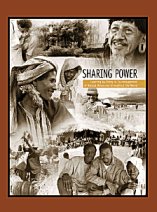
Sharing
Power: Learning-By-Doing in Co-Management of Natural
Resources Throughout the World
by
Grazia Borrini-Feyerabend, Michel Pimbert, M. Taghi
Farvar, Ashish Kothari and Yves Renard, with
Hanna Jaireth, Marshall Murphree, Vicki Pattemore, Ricardo
Ramirez and Patrizio Warren
A
joint publication by IIED and IUCN/CEESP, November 2004
Link to Ordering information
|
At
the heart of ‘co-management’ of biodiversity
and natural resources is a process of collective understanding
and action by local communities and other social actors.
The process brings about negotiated agreements on management
roles, rights, and responsibilities, making explicit
the conditions and institutions of sound decentralized
governance. De facto, co-management is about sharing
power. When successful, it spells out the peaceful and
intelligent ways by which communities and other actors
overcome environmental challenges, take best advantage
of nature’s gifts and share those in fairness
and solidarity. When it fails, it ushers conflict, human
misery and environmental damage.
This
book is designed to support professionals and citizens
at large who wish both to better understand collaborative
management processes and to develop and enhance them
in practice. It begins by offering a variety of vistas,
from broad historical and equity considerations to in-depth
co-management examples. The understanding accumulated
in recent decades on the appropriate starting or entry
points for co-management, pre-requisites for successful
negotiations (such as effective social communication
and internal organization of the parties) as well as
rules, methods and conditions of the negotiations themselves
are illustrated in detail. Methods and tools, such as
practical checklists distilled from different situations
and contexts, are offered throughout. Examples of specific
agreements and pluralist management organizations are
discussed. The experience of social actors learning
by doing and improving their management practices on
an on-going basis has informed this book— together
with the complex and inspiring ways by which the surrounding
socio-political conditions can be improved through participatory
democracy.
Download chapters
of Sharing Power |
 |
New publication from the Reclaiming Diversity and Citizenship Series:
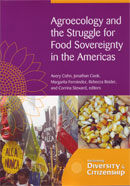
Agroecology and the Struggle for Food Sovereignty in the Americas - by Avery Cohn, Jonathan Cook, Margarita Fernandez, Kathleen McAfee, Rebecca Reider, and Corrina Steward (Editors)
Co-published by Yale School of Forestry and Environmental Studies, IUCN/CEESP and IIED, this publication is Volume 2 in the Reclaiming Diversity and Citizenship series.
|
| This book seeks to examine the political, economic, cultural, and ecological dimensions of food sovereignty; generate and exchange technically informed and practically applicable knowledge; and provide an interactive space for the formation of cross-cultural alliances between the U.S. and Latin America among academics and practitioners. It addresses a recurring question on how to build stronger relationships between academics and practitioners, including farmers and NGOs, working at the intersection of food, agricultural, and environmental issues. With foreword by Michel Pimbert and Taghi Farvar. |
| Link to Ordering information and Downloadable Version |
|
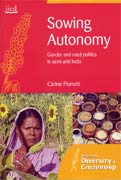
Sowing
Autonomy: Gender and Seed Politics in Semi Arid India
Reclaiming
Diversity and Citizenship Series
Carine
Pionetti
September
2005
1
84369 562 6 (ISBN)
Price:
$30.50 US (£17.00 UK), £5.00 to Non-OECD
countries, £10.00 to students
|
|
|
The author of this book looks in particular at women’s
roles in saving and reproducing seed in the drylands of
the Deccan Plateau, in South India. Detailed farmers’
accounts of why seed-saving is essential emphasise the
interconnectedness between self-reliance in seed, crop
diversity and nutrition. By extension, the realms of food
culture and religious rituals (which entail the use of
traditional crops) are also linked to seed autonomy. What
is most significant about the intertwining of seed-saving,
crop diversity and nutrition is that these three realms
are largely under women’s control. However, the
processes of industrialisation and institutionalisation
in the seed sector are undermining the very basis of autonomous
seed production. A radical re-orientation in public policies
is needed to support autonomous seed production in the
drylands of South India. Poverty alleviation and biodiversity
conservation both directly depend on a) the strengthening
of diversity-based farming systems, b) institutional support
for decentralised seed systems, and c) reversals in policies
for technological and legal developments. |
| Link
to Ordering information
and Downloadable Version |
 |
A
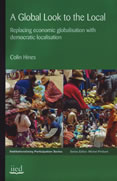
Global Look to the Local: Replacing economic globalistion
with democratic localisation
Colin Hines
2004,
71pp
1 84369 5000 6
$22.50/£15
Order No. 9308IIED
|
This
Discussion Paper seeks to identify the forms
of economic organisation that might best support
the institutionalisation of participation and
people centred processes in environment and development.
Written in a non academic and accessible style,
the paper renews with traditions of political
and economic philosophy that propose ethical
norms to guide social relations and the organisation
of economic life.
Using
food systems as a unifying example, the author shows
how localisation reverses the trend of corporate
globalisation by discriminating in favour of the
local. This approach to organising economic life
has local self-reliance and the potential to increase
self-determination at its core. A set of mutually
reinforcing policies that can potentially increase
control of the economy by communities and nation
states are described. Localisation has the potential
to foster and help institutionalise democratic participation
in its broadest sense. For example it is anticipated
that 'economic democracy' will occur via involvement
in increasingly diverse national production. More 'electoral
democracy' is likely since people have a greater
incentive to vote when local and national governments
have greater control over their own economies. Forms
of direct and participatory democracy can also spread
and become institutionalised under a localisation
approach that introduces a guaranteed citizen income
and re-affirms a commitment to self-determination.
|
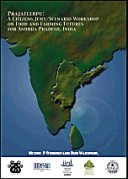
Pimbert,
M. and Wakeford, T. 2002
Prajateerpu: A citizens jury / scenario workshop
on food and farming futures in Andhra Pradesh, India
London: IIED |
 |
 |
| |
View PDF (English
874K) |
View
PDF (Telegu 671K) |
This
paper describes and analyses the process and conclusions
of a citizens' jury which was convened in Andhra Pradesh
(AP), India, to discuss future scenarios for food and farming
in the state. The jury process was convened partly in response
to the Government of AP's proposed 'Vision 2020' for the
future of agriculture and food production in AP. Members
of the jury were drawn from communities of small and marginal
farmers from all over the state of AP, and most were either
dalits (from the 'untouchable' caste) or adivasis (tribal
peoples), and women formed the majority. The jurors' deliberations
were informed by their interrogation of a range of witnesses
including those from the Government of AP, a transnational
agrochemical company (Syngenta), universities, local NGOs
and government advisory panels. Facilitators used a range
of methods to give jurors the opportunity to validate their
knowledge and challenge the misunderstandings of decision-makers.
Although there was a significant diversity of opinion among
the jury participants, there was widespread agreement on
their final statement, which included the following:
We oppose:
-
the proposed reduction of those making their livelihood
from the land from 70 per cent to 40 per cent in Andhra
Pradesh
-
land consolidation and displacement of rural people
-
contract farming
-
labour-displacing mechanisation
-
GM Crops—including Vitamin-A rice & BT-cotton
-
loss of control over medicinal plants including their
export
-
food and farming for self reliance and community control
over resources
-
To maintain healthy soils, diverse crops, trees and livestock,
and to build on our indigenous knowledge, practical skills
and local institutions.
Pimbert,
M. and Wakeford, T. 2002
Prajateerpu: Food and Farming Futures for Andhra
Pradesh: A Citizens' Jury / Scenario Workshop
Economic and Political Weekly [India] 37
(27) (Review of Science Studies), 6-12 July: 2778-87
View
PDF
In
many countries 'representative' democracy that relies
on the accountability of elected politicians has been
heavily criticised for its frequent inability to protect
the interests of a large proportion of its citizens. Over
the past quarter century a number of 'participatory' methods
have been developed to supplement conventional democratic
processes by moving beyond traditional forms of consultation.
Increasingly, the introduction of new technologies and
all policy processes involves making decisions without
being able to predict the effects of different courses
of action. Participatory methods can be invaluable in
such situations. Prajateerpu - a citizens' jury on food
and farming futures in Andhra Pradesh - was a six-day
exercise in deliberative democracy involving marginal-livelihood
citizens from the different regions of the state. A report.
Pimbert,
M. and Wakeford, T. (2003)
Prajateerpu, power and knowledge: The politics
of participatory action research in development.
Part 1: Context, process and safeguards
Part 1:
Action
Research 1 (2): 185-207
View
PDF (159k)
Prajateerpu
(translation: 'people's verdict') has been devised as
an exercise of allowing those people most affected by
the 'Vision 2020' for food and farming in Andhra Pradesh
(AP, India) to shape a vision of their own. We explore
Prajateerpu as a case study in participatory action research
that took place against a background of social, political
and scientific controversy in which we were active participants.
Having examined different methods in combination, including
the citizens' jury, scenario workshop and public hearings
involved in the Prajateerpu process, we assess the safeguards
that were put in place to ensure a balanced and credible
deliberative process. We suggest that the exchanges between
the five organisations that formed the core team, the
facilitators, oversight panel, witnesses and jurors in
Prajateerpu, along with the use of a set of carefully
designed safeguards, may contain valuable lessons for
those who wish to engage in collaborative inquiries where
the political stakes in the outcome of this way of knowing
are high.
Wakeford, T. and M.P. Pimbert (2004)
Prajateerpu,
power and knowledge:
The politics of participatory action research in development
Part 2: Analysis, reflections and implications
View
PDF (138k)
We examine the roles of the diverse co-inquirers involved
in the power-equalising action research project known
as Prajateerpu. While privileging neither official expertise
nor experiential knowledge over the other, we suggest
the need to create arenas where expert knowledge is put
under public scrutiny as a means of contributing to a
redressing of the power imbalance that exists between
the poor and elite social groups. We emphasise the important
tensions that arose in Prajateerpu between the views
of those participants whose analysis had become marginalised
from decision-making processes and those who were positions
of power. Having reflected on our own actions as action
researchers, we look at the potential contributions processes
such as Prajateerpu could have towards processes that
aim to democratise knowledge and promote social justice.
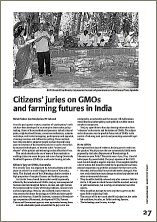
Pimbert,
M., Wakeford, T. and Satheesh, P. V. 2001
Citizens' juries on GMOs and farming futures in
India
LEISA Magazine on Low External Input and Sustainable
Agriculture 17 (4): 27-30
View
PDF |
|
Over
the past quarter century a number of participatory methods
have been developed to democratise policy-making. The citizens'
jury is one such method that is being used widely to get
farmers involved in the debate on GMOs, which has a direct
impact on their lives and livelihoods. This article describes
two such juries conducted in India, in Karnataka and Andhra
Pradesh. In both instances, the farmers clearly said 'no'
to GMOs, and supported localised food systems instead.
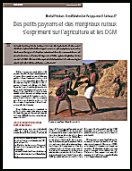
Michel
Pimbert, Tom Wakeford et Periyapatna V. Satheesh
Des
petits paysans et des marginaux ruraux s'expriment
sur l'agriculture et les OGM
La
Revue Durable No.6 (2003)
En
Inde, en Afrique et en Amérique du Sud,
des expériences de démocratie
délibérative permettent à des
marginaux ruraux – petits paysans, paysans sans
terre, ouvriers agricoles et petits transformateurs
et consommateurs – de
donner leur avis sur l’avenir de l’agriculture
et les organismes génétiquement
modifiés (OGM).Cet article décrit quatre
de ces expériences.Toutes convergent
vers le rejet des OGM actuellement sur le marché.
View
PDF (1.45Mb)
|
 |
 |
CERIN/ LaRevueDurable
Rue de Lausanne, 91
1700 Fribourg
Suisse
www.cerin.ch
|
Pimbert,
M.P. 2002
Towards Democratic Control and Participation in
the Management of Agricultural Biodiversity
See
Web Site...
"Community
based conservation" and "peoples' participation" have
become part of the conventional rhetoric
and more attention is being paid to this
approach
on the
ground by international
and national organisations. There are now
several examples of projects which involve
local communities
in conserving
and sustaining biodiversity important for
food, agriculture, health, local livelihoods
and
culture in a variety
of settings.
However,
community based or local management of agricultural biodiversity
remains a relatively isolated practice. Its spread to more
people and places is constrained by at least three interrelated
and mutually reinforcing trends:
- public
sector and civil society organisations that understand
"participatory" development in ways that cede little or
no devolution of power to local communities engaged in
conservation and development
- the
emerging structure, organisation and reach of the global
food system that yields disproportionate benefits to corporations
and their shareholders.
- development
options that increasingly shift economic power and control
over policies, resources and institutions from local citizens
to global corporations.
This
paper identifies some of the reforms needed to encourage
democratic participation and more genuine local control
in the management of agricultural biodiversity. Emphasis
is placed on strengthening diversity, decentralisation and
democracy through the regeneration of more localised food
systems and economies.
Pimbert,
M.P. (2002).
Social learning for ecological literacy and democracy:
emerging issues and challenges.
Proceedings
of the International Learning Workshop on Farmer Field
Schools (FFS): Emerging Issues and Challenges, 21-25
October 2002, Yogyakarta, Indonesia. CIP UPWARD, The
Rockefeller Foundation, FAO and Field.
View
PDF (344k)
In
essence, farmer field schools (FFS) are
a form of social learning, negotiation, and effective
collective
action
that
focuses on society's relationship with
nature. The spread and scaling up of
FFS principles
from integrated
pest
management
(IPM) in rice to other areas have been
remarkable. However, much still needs
to be done. This
paper discusses three
broad challenges and emerging issues
for FFS futures:
1.
Social learning for ecological literacy and democracy. The
dynamics of self-discovery learning and participatory action
are needed to expand knowledge of agroecology for sustainable
agriculture, people-environment interactions, and deliberative
democracy.
2. Institutionalizing
social learning and participation. Different understandings
and meanings of participatory development lead to fundamentally
different approaches to mainstreaming social learning and
participation.
3.
Regoverning food systems and the commons. New forms
of governance are needed to safeguard the rights, livelihoods,
and environments of farmers and other citizens confronted
by rapid and uncertain global change.
|
|
| |
|