Introduction The
research adopts an international, action oriented, interdisciplinary
and case study approach that builds on the expertise of local
resource users and national and international partners. After
a period of consultation with possible partner organisations
and various international advisors, criteria
were listed for the selection of country case studies.
Case
studies are being conducted in India,
Indonesia
Iran
and Peru.
Each case study aims to explicitly analyse the linkages between
social, economic and ecological systems through its objective
to relate management practices based on ecological understanding
to the social processes behind these practices.
The
process of conducting research is considered at every step
as important as the ultimate findings. The research agenda
and priorities for each country case study have been arrived
at through extensive participatory
dialogue with partners. The participatory process also
clarified the roles, rights and responsibilities of local
partners and IIED, with the adoption of a code
of ethics. The participatory dialogue also resulted in
some innovations in the medium
of research documentation.
In each country case study, the research team is complemented
by a National Learning Group. This NLG draws together key
people from different hierarchical levels and sections within
government bureaucracies, civil society organisations, and
the private sector to analyse the creative tasks that have
led to or are needed for the adaptive management of agricultural
biodiversity and the maintenance and enhancement of localised
food systems.
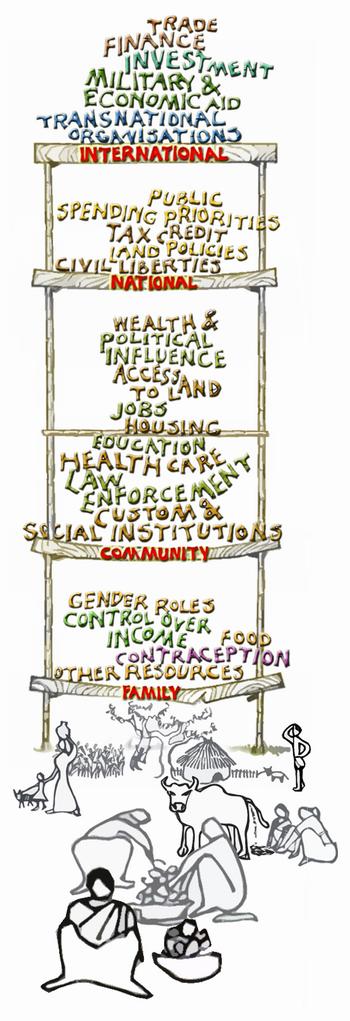
Linking the local to the international: a power structures
perspective
Various
structures of decision making power influence the dynamic
relationships between agricultural biodiversity, livelihoods
and food systems. These structures include the distant arenas
of trade, finance and international agreements and extend
downwards to the level of national government, on through
the village, to the relationships within households.
Each
case study uses a variety of complementary methodologies to
better understand how key local, national and international
decision making structures influence the dynamics of “Sustaining
Local Food Systems, Agricultural Biodiversity and Livelihoods”.
Some of the arenas of decision making power examined include
gender relations, access to land and other property rights
within families and communities, national public spending
priorities and agricultural development policies, as well
as international trade, global corporations and emerging international
norms. Examples of the latter include:
A
one day
international workshop was also organised in the UK, in
July 2001 in response to a felt need from partners to learn
and to demonstrate how a local-food approach can be integrated
into national, regional and global food and agricultural policies.
The research teams are employing participatory research methods,
for analyses of livelihoods, agroecosystems and landscapes,
market relations, organisations and impact analysis. Historical
analysis and complementary methods from the social and natural
sciences are also used.
Analysis of the case studies will lead to the identification
of key constraints faced, favourable conditions of success,
and prerequisites for success in the decentralised management
of agricultural biodiversity. This later analysis will be
based on a consideration of:
-
key goods and services provided by biological diversity
for rural livelihoods and localised food systems
-
best management practices
-
the knowledge and social mechanisms behind the management
-
adaptations in local fora and institutional arrangements
to local ecosystem and landscape characteristics
-
additional capacity building needs of local resource management
fora and networks
-
supportive marketing and trade policies, and legal and economic
measures at international and national levels.
The
project will culminate in national and international workshops
where the policy implications are reviewed. Each case study
will outline a strategy for long term capacity building and
the strengthening of local platforms set up for adaptive management
of agricultural biodiversity and localised food systems. |